Why the future of leadership requires alignment, awareness, and a more human-centered approach
I’ve been sitting with a question lately:
What if burnout isn’t the problem, but is instead information?
For years, we’ve treated burnout as something to recover from, to eliminate, or to manage. We talk about prevention strategies, resilience practices, self-care routines, and wellness initiatives. We ask what people need in order to keep going.
These things do matter, and yet, I wonder if sometimes our focus on fixing burnout causes us to miss what burnout may be trying to tell us.
Because what if burnout isn’t a failure, but it’s feedback?
What if it’s the body’s way of saying: Something here is no longer aligned.
Not all at once. Not dramatically.
But slowly. Quietly. Gradually.
A drift we don’t notice until we do because drift rarely announces itself.
It doesn’t arrive with flashing lights and clear instructions.
More often, it arrives as subtle compromises:
The meeting we agree to attend even though our capacity says otherwise.
The boundary we postpone because it feels inconvenient.
The values we place on hold in service of urgency.
The leadership style we adopt because it’s what the organization rewards, even though it doesn’t feel like our own.
The pace we normalize because everyone around us seems to be running at the same speed.
One decision at a time. One accommodation at a time. One season at a time.
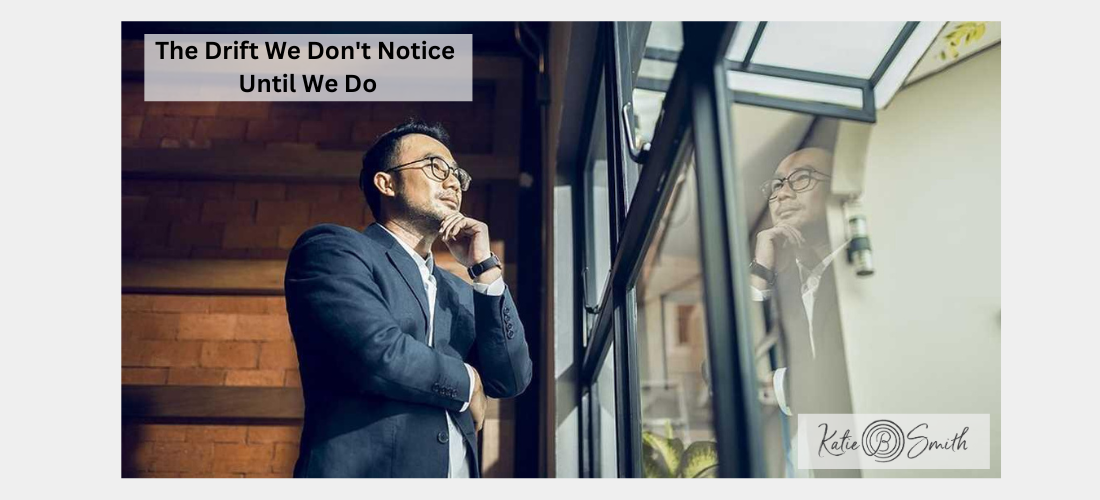
Until eventually we look up and realize we don’t quite recognize ourselves in the way we’re living or leading.
I hear versions of this from leaders all the time:
“I don’t know when work started feeling this heavy.”
“I am working 60 hours a week and weekends.”
“I feel like I’m constantly responding rather than intentionally leading.”
“I have no time to reflect; I am in back-to-back meetings all day.”
Those words are about more than exhaustion. They’re often describing distance from ourselves, our values, our bodies, and from the kind of leaders we hoped we would become.
Burnout, in that sense, may not be the problem, just simply the messenger:
You have drifted too far from yourself to continue this way.
I don’t say this to place responsibility solely on individuals. Far from it.
Organizations matter. Systems matter. Culture matters. Workloads matter.
There are environments that make alignment easier, and environments that make it nearly impossible.
Many organizations continue to reward urgency over intentionality, availability over sustainability, and performance over presence.
Leaders are asked to deliver results, navigate uncertainty, support well-being, lead change, manage complexity, and somehow remain endlessly available while doing it.
It’s no wonder so many leaders feel disconnected from themselves.
The Leadership Transition We Don’t Talk About
I think this is especially true for emerging leaders.
Many emerging leaders are promoted because they are exceptional individual contributors. They know how to get things done. They are reliable, capable, and often the person others turn to when something needs to be solved.
But the transition into leadership requires something different. It requires moving from doing to empowering others, from having the answers to creating space for others to find solutions, from being the person who carries the work to the person who creates the conditions for others to succeed.
Yet many emerging leaders get stuck in the role that made them successful in the first place.
They continue operating as the person who solves, fixes, responds, and carries.
They measure their value by how much they accomplish, how quickly they respond, and how much they can personally hold.
Over time, this creates a disconnect.
They may have the title of leader, but they are still operating from the mindset of an individual contributor. And that gap can become exhausting.
Because leadership asks us to release some of the behaviors that helped us get here in order to step into the behaviors that will help us lead what’s next.
The work is not just learning new leadership skills.
The work is becoming a different version of ourselves.
This is why leadership is not simply a competency exercise. It is identity work, awareness work, and alignment work.
The Leaders Who Create Healthy Cultures
The healthiest organizations I encounter have one thing in common:
Their leaders know themselves.
Not perfectly. Not completely. But intentionally.
They understand what matters to them, their strengths, their limitations, their values, the conditions under which they thrive, and they understand the difference between pressure and purpose.
Most importantly, they pay attention when they begin to drift. Because drift itself is not failure; it is part of being human.
We all move away from ourselves from time to time.
The question is not whether drift will happen; it is how quickly we notice, and what support exists to help us return.
Aligned leaders create clarity, trust, and psychological safety, as well as permission for others to lead from a place of humanity rather than performance alone.
The Future of Leadership Is Human Centered
Perhaps the next evolution of leadership is something even deeper.
The future of leadership is not about asking people to become more productive, more resilient, or more adaptable. It is about becoming more human.
Human-centered leadership recognizes that people are not resources to optimize.
They are whole human beings who bring their experiences, values, strengths, challenges, and potential into the workplace every day.
It asks leaders to move beyond managing performance alone and begin understanding the person behind the performance.
Because people do not bring only their skills to work. They also bring their hopes, fears, creativity, lived experiences, capacity, and humanity.
Human-centered leaders understand that sustainable performance is built through connection, trust, clarity, and care.
This does not mean lowering expectations or avoiding accountability.
It means recognizing that the strongest organizations are built when people feel seen, valued, and able to contribute as their whole selves.
The shift is moving
From: “What can I get from my people?”
To: “What conditions do my people need to thrive?”
From: “How do I get more out of my team?”
To: “How do I help my team become more of who they are?”
From: “How do I fix burnout?”
To: “How do we create environments where people don’t have to abandon themselves to succeed?”
This is the heart of human-centered leadership.
It begins with leaders who are willing to look inward, understand themselves, and lead from a place of alignment because the way we lead others will always be influenced by the way we relate to ourselves.
Alignment Rarely Happens Alone
For many leaders, the challenge isn’t a lack of capability. It’s a lack of space to think, to reflect, and to ask the questions that rarely make it onto meeting agendas:
Is this how I want to lead?
Am I becoming the leader I intended to become?
What assumptions am I carrying that no longer serve me?
Where am I acting from obligation rather than alignment?
What am I tolerating that is quietly depleting me?
What have I normalized that my body has not?
These are not luxury questions; these are leadership questions.
Because leadership is not simply about what we do; it’s about who we are while we are doing it.
And alignment rarely happens alone.
Most of us cannot see our own drift while we are living inside of it.
We need other people who help us hear ourselves think, who ask better questions, who reflect back what they notice, and who remind us who we are when we’ve temporarily forgotten.
Leadership was never meant to be a solitary practice.
This is one of the reasons I believe so strongly in peer group coaching because leaders need spaces where they don’t have to carry leadership alone, where uncertainty is allowed, where reflection is valued, and where people can think out loud before they reach the point of exhaustion.
There is something powerful that happens when leaders realize they are not the only ones wrestling with difficult decisions, impossible expectations, or questions of identity and purpose.
Isolation softens. Perspective expands. Wisdom becomes collective instead of individual.
Perhaps, most importantly, people begin to notice their drift sooner before exhaustion becomes burnout, disconnection becomes disengagement, and over functioning becomes identity.
Peer coaching is not simply a leadership development strategy, but an alignment and remembering practice that serves as a place to return to ourselves in the company of others who are doing the same work.
Because most of us don’t lose ourselves all at once, but gradually, and we often find ourselves the same way – gradually – through conversation, reflection and choice.
Perhaps the invitation hidden inside burnout is not to become stronger, more resilient or more curious, but to pay attention to where we have drifted, to notice what we have normalized, and to consider what alignment might feel like now.
If you’re noticing signs of drift in your own leadership, perhaps the question is:
Who helps you notice when you’ve moved too far away from yourself?
Remember that returning to ourselves was never meant to be a solo journey and rarely happens alone.
This belief is at the heart of my work with leaders — creating spaces where people can think out loud, challenge assumptions, gain perspective, and reconnect with how they want to lead.
Through Peer Leadership Circles, leaders come together in confidential communities to explore the questions that often don’t have room to surface in the day-to-day pace of leadership.
Questions about identity.
Questions about impact.
Questions about alignment.
Questions about who they are becoming as leaders.
Because sometimes the most powerful shift doesn’t come from learning one more leadership skill; rather it comes from having the space and support to remember the leader you already are.
If this resonates, I invite you to explore what a Peer Leadership Circle could make possible for you or your organization.