Issue #1 — Wanting change, but not having the energy or internal capacity to create it.
There’s a strange display happening right now –
At work. Online. In group chats. In interviews. In meetings.
Everyone keeps acting like they’re handling the pace of change just fine, especially with new AI tools every week, new expectations, new workflows, entire industries appearing while others quietly collapse, and careers being redefined in public.
Somehow the acceptable response is “exciting times.”
But underneath that display, there’s a quiet fear sitting in the nervous system and the psyche.
Privately, people are exhausted.
Not because humans hate change.
Humans actually adapt remarkably well.
What wears people down is continuous adaptation without recovery.
There used to be seasons in life.
You learned a system.
You got good at it.
You stabilized.
Eventually things changed again.
Now the system changes while you’re still learning the previous system.
Before you adjust to one platform, role, economy, or social norm, another update arrives.
The modern worker is expected to:
• continually learn
• stay emotionally regulated
• remain publicly optimistic
while still performing at a high level.
That’s not resilience; that’s cognitive and capacity overload.
And the strangest part?
A lot of people no longer know whether they’re tired from:
• actual work
• decision fatigue
• constant uncertainty
• information saturation
• pressure to continuously reinvent themselves
When everything changes all the time, the brain stops treating change as an event.
It starts treating instability as the baseline.
That’s when people begin to feel numb.
You can see it everywhere:
•employees disengaging while still performing
•creators burning out faster
•people consuming productivity content they’re too exhausted to apply
•conversations sounding increasingly automated
•growing nostalgia for slower, more predictable eras
Even self-improvement has become exhausting.
Optimize your sleep.
Optimize your diet.
Optimize your workflow.
Optimize your attention.
Optimize your personality.
Optimize your career before AI optimizes it for you.
At some point, optimization itself becomes a stressor.
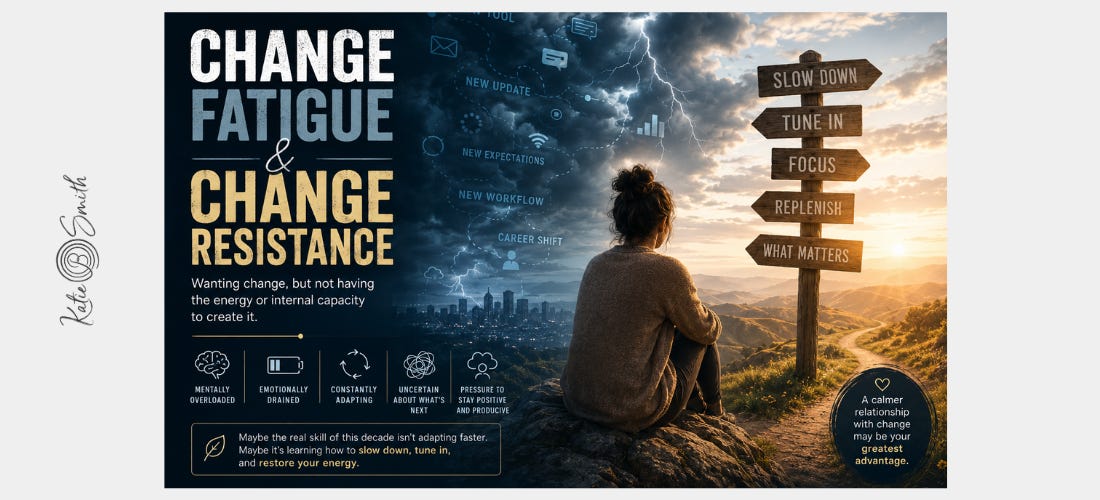
Perhaps the real skill of this decade isn’t adapting faster, but instead, it’s learning how to slow down long enough to hear what you actually need in order to restore your energy.
A calmer relationship with change may become a competitive advantage.
People who can stay grounded while everyone else is overstimulated will likely think more clearly, work more sustainably, and make better long-term decisions.
The future may belong less to the fastest adapters and more to the people who can adapt without fragmenting themselves in the process.
Those people become stabilizing forces in the middle of chaos.
When we embody that kind of steadiness, it gives others permission to soften, to regulate, and to feel supported.
Questions to Ponder
What changes in your life are actually important?
Which ones are just noise demanding your attention?
When change fatigue or resistance appears, what happens if you respond with gentleness instead of judgment, and ask what’s underneath it?
What do you — and your body — genuinely need in order to move through this change consciously and sustainably?